Ruvexariqer
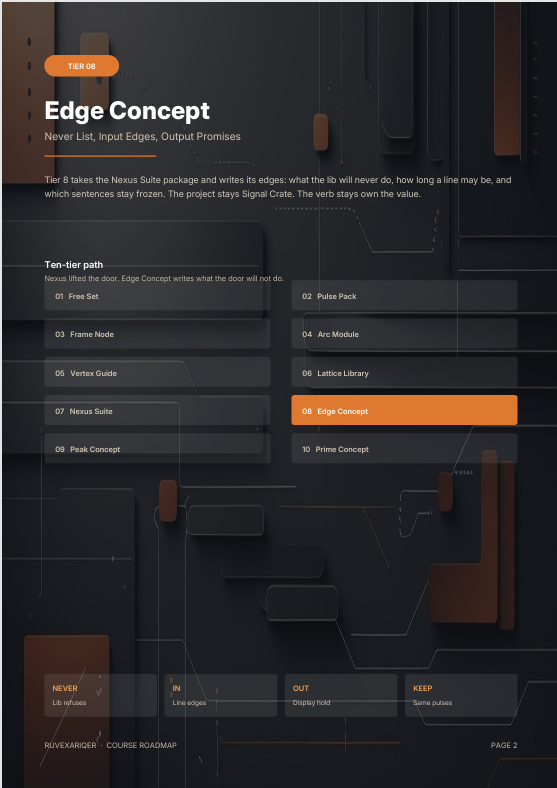
Edge Concept
Edge Concept
Couldn't load pickup availability
- 💾 Digital file available after purchase
- 📚 Long-term availability
- 🔒 Secure checkout
- 🗓️ Content updated in 2026
Self-paced learning overview
Problem Statement
As Rust programs become more complex, learners may encounter situations where basic ownership patterns are no longer enough to describe how data is stored, shared, or modified.
Some structures need several parts of a program to refer to related data. Other situations require behavior to be selected dynamically, or data to be changed through patterns that differ from ordinary mutable borrowing.
Learners may also begin to see lower-level operations that require additional reasoning about memory relationships and program assumptions.
Without a structured approach, these topics can feel disconnected and difficult to compare.
Solution
Edge Concept organizes these subjects around one central idea: understanding how Rust represents more complex relationships between memory, types, and behavior.
The course begins with smart pointer patterns and shared ownership concepts before moving into interior mutability. Learners then explore trait objects and dynamic dispatch as ways to work with different types through shared behavior.
Later sections introduce advanced type relationships and the role of unsafe Rust at a conceptual level, with emphasis on understanding why additional responsibilities are required when ordinary compiler checks are intentionally bypassed.
What’s Inside
Edge Concept includes structured lessons, diagrams, examples, and exercises covering:
- Smart pointer patterns
- Shared ownership structures
- Reference-counted data concepts
- Interior mutability
- Runtime borrowing concepts
- Trait objects
- Dynamic dispatch
- Advanced type relationships
- Wrapper and pointer-like structures
- Memory reasoning
- Unsafe Rust concepts
- Program invariants
- Boundaries between ordinary and lower-level operations
- Connecting memory structure with ownership rules
Earlier material on traits, lifetimes, ownership, borrowing, and shared structures is revisited throughout the course.
Who Is This For?
Edge Concept is intended for learners who already understand ownership, borrowing, lifetimes, traits, generics, smart pointer basics, and concurrent programming concepts.
It is suitable for learners continuing through the Ruvexariqer sequence or for those who want to study deeper memory and type relationships in a structured way.
What You’ll Learn
- Recognize common smart pointer patterns
- Understand basic shared ownership relationships
- Explain the idea behind interior mutability
- Follow runtime borrowing relationships
- Understand how trait objects represent shared behavior
- Recognize the role of dynamic dispatch
- Compare static and dynamic behavior selection
- Read more detailed type relationships
- Follow pointer-like structures through a program
- Reason about memory ownership in broader structures
- Understand the conceptual role of unsafe Rust
- Identify why program invariants matter
- Recognize boundaries that require additional programmer responsibility
- Connect advanced memory patterns with earlier ownership concepts
Refund Policy
A refund request may be submitted within 30 days of purchase, subject to the conditions described in the Ruvexariqer Refund Policy.
This section explains the available refund request period and does not make claims regarding individual learning outcomes.
Certification
The course includes a certificate of completion, giving learners a clear way to record completion of the included Edge Concept materials.
Share
Is a certificate included?
Is a certificate included?
Yes. Each course includes a certificate of completion that gives learners a clear record of completing the included learning material.
Do I need previous Rust knowledge?
Do I need previous Rust knowledge?
Course requirements vary by tier. Earlier tiers introduce foundational ideas, while later tiers move toward broader programming concepts and more detailed practice.
What format are the courses provided in?
What format are the courses provided in?
Ruvexariqer courses are organized into written lessons, structured modules, practical explanations, and supporting learning materials designed for independent study.