Ruvexariqer
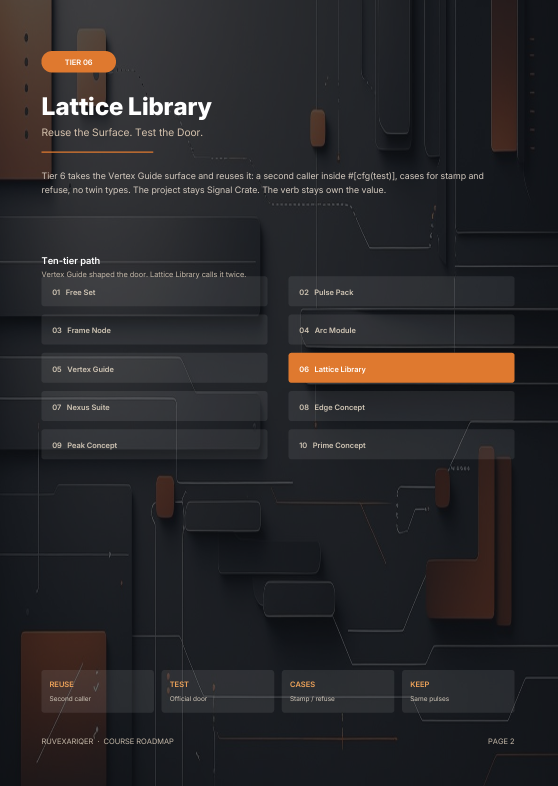
Lattice Library
Lattice Library
Couldn't load pickup availability
- 💾 Digital file available after purchase
- 📚 Long-term availability
- 🔒 Secure checkout
- 🗓️ Content updated in 2026
Self-paced learning overview
Problem Statement
As programs become more detailed, learners may begin writing long sequences of loops and repeated operations to process collections. Similar logic can appear in several places, making the structure harder to follow and increasing the amount of code that needs to be reviewed.
Another challenge appears when functions need to carry behavior as values or when data must be shared through more flexible structures. These ideas can feel disconnected if closures, iterators, and pointer-related concepts are studied separately.
The main difficulty is understanding how these tools work together and when each approach is useful.
Solution
Lattice Library introduces closures as reusable pieces of behavior that can work with surrounding data. Learners then explore iterators and see how sequences of values can move through organized processing steps.
The course connects iterator operations with closures so learners can study how filtering, mapping, combining, and collecting data can be expressed through clear processing chains.
Later sections introduce smart pointer concepts and shared structures at an introductory level, helping learners see how ownership rules can be extended to more flexible data relationships.
What’s Inside
Lattice Library includes structured lessons, diagrams, examples, and exercises covering:
- Closure syntax and behavior
- Capturing surrounding values
- Iterator basics
- Iterator adaptors
- Mapping data
- Filtering values
- Chaining operations
- Collecting processed results
- Composing multiple operations
- Smart pointer concepts
- Shared ownership ideas
- Interior data relationships
- Connecting iterators with ownership rules
Earlier topics such as collections, traits, generics, borrowing, and error handling are revisited where they support these new concepts.
Who Is This For?
Lattice Library is intended for learners who already understand Rust fundamentals, ownership, collections, generics, traits, and basic lifetime relationships.
It is suitable for learners continuing through the Ruvexariqer sequence or for those who want to study more organized approaches to data processing and reusable behavior.
What You’ll Learn
- Create closures for reusable behavior
- Understand how closures interact with surrounding values
- Work with iterator-based data sequences
- Apply mapping operations to collections
- Filter values using conditions
- Chain several iterator operations together
- Collect processed values into new structures
- Compare iterator-based processing with manual loops
- Connect closures with generic behavior
- Recognize introductory smart pointer patterns
- Understand basic shared ownership concepts
- Follow data flow through composed operations
- Organize repeated processing into clearer sequences
- Relate iterators and closures to earlier ownership concepts
Refund Policy
A refund request may be submitted within 30 days of purchase, subject to the conditions described in the Ruvexariqer Refund Policy.
This section explains the available refund request period and does not make claims regarding individual learning outcomes.
Certification
The course includes a certificate of completion, giving learners a clear way to record completion of the included Lattice Library materials.
Share
Is a certificate included?
Is a certificate included?
Yes. Each course includes a certificate of completion that gives learners a clear record of completing the included learning material.
Do I need previous Rust knowledge?
Do I need previous Rust knowledge?
Course requirements vary by tier. Earlier tiers introduce foundational ideas, while later tiers move toward broader programming concepts and more detailed practice.
What format are the courses provided in?
What format are the courses provided in?
Ruvexariqer courses are organized into written lessons, structured modules, practical explanations, and supporting learning materials designed for independent study.